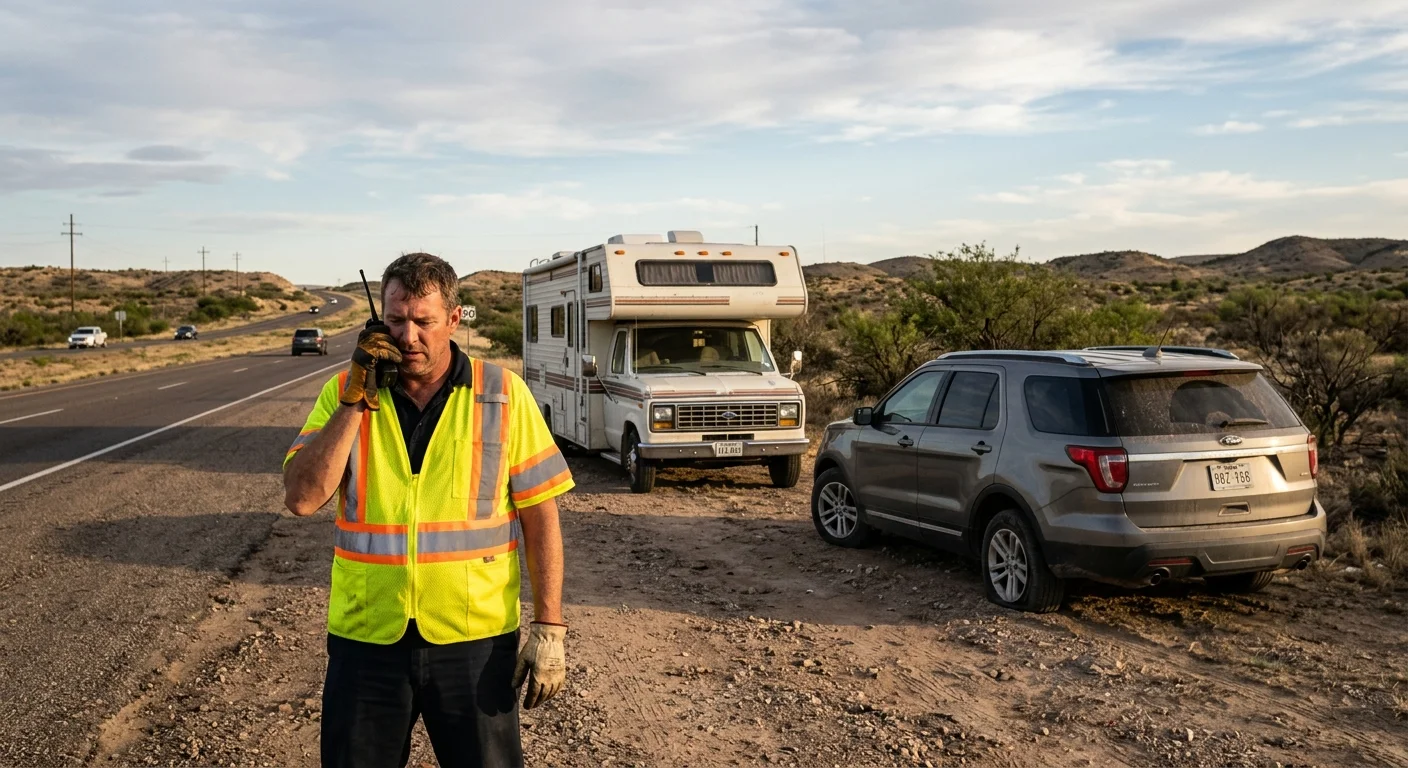
You’re on the shoulder with a motorhome that still runs and a passenger car that will not. The car is the job. Dispatch has to hear that before anyone assigns a truck, because a dead toad is not a dead Class A, and it is not a fifth wheel sitting in a stall.
Identify the RV and the car it was towing
Start with two vehicles, not one. Name the motorhome, travel trailer, or fifth wheel that was pulling. Then name the car that was behind it. Make, model, year, and color. Say whether it is a sedan, crossover, pickup, or EV. Say whether it is still on a tow bar, still on a dolly, still on a trailer, or already unhooked on the shoulder.
Quick Tow El Paso is a dispatch line. We connect you with a licensed, insured operator. We do not own the wrecker, and we do not run a yard. The driver who takes the job needs to know which unit is disabled. A Class A on I-10 at Mesa is one kind of work. A Honda sitting four-down behind it is another. If the motorhome is fine and only the tow car for the RV is dead, say that in the first sentence.
If the fifth wheel is the problem, that is a different call. Use our rundown of what dispatch needs when a fifth wheel is in trouble. Keep this page on the passenger vehicle.
Keys and gear matter as much as the badge on the hood. Say whether you have the car keys. Say if it sits in park, sits in neutral, or will not shift. Do not guess whether the factory approved four-down towing. That lives in the owner’s manual, usually under recreational towing or dinghy towing. If the manual is silent, treat four-down as unconfirmed and tell the operator that. We will not publish a list of which cars can roll behind a motorhome. Year, drivetrain, and options change, and a copied list is how transmissions get ruined.
Tesla and other EVs have their own limits. Start with whether you can flat-tow a Tesla behind an RV, then open your own manual. Do not assume a gas sedan and an EV load the same way.
Mention a dolly or trailer if it is still in the combination. A car plus dolly is longer than a car on a bar. The operator needs that length before they pick a truck.
Describe what can still roll and steer
Tell dispatch what the car can still do. Will it roll in a straight line if you take it out of park. Do the front wheels turn. Is a tire shredded, a wheel gone, or the steering locked. Can you release the parking brake. Those answers decide how the operator approaches the hook.
This is how they choose a wheel-lift versus a flatbed tow. We do not promise a method on the phone. We pass what you see. A car that will not roll, a locked column, a seized brake, or an all-wheel-drive unit the manual forbids from rolling is usually a bed job. A car that rolls and steers may take a different hook. The driver confirms that on scene.
Do not diagnose transmission damage from dinghy towing while you are on the shoulder. If you heard grinding, smelled fluid, or felt the wheels lock when you unhooked, say what you heard and saw. Point the operator at the manual and at the car in front of them. Manufacturer instructions are the authority. We are not.
If you already unhooked, say where the tow bar, base-plate arms, safety cables, and light harness are. Loose gear on a West Texas shoulder is a hazard of its own. If the car is still attached to the motorhome, say that too. The operator may ask you to unhook, or may want the combination left alone until they arrive. Follow the driver.
If the RV can still move and the car cannot, say whether you can pull the motorhome forward off the car. Do not drag the toad to “make room.” Ask before you move anything. A short pull that twists a bar can turn a roll-on recovery into a winch-and-bed recovery.
Photos help. One of each vehicle, one of the hitch, one of the tires, one of the approach. Keep yourself out of the travel lane while you shoot them.
Share the exact breakdown location
El Paso is not one shoulder. A pin downtown is not a pin on the farm road through Socorro. Give the highway or street, the direction of travel, the nearest exit or cross street, and which side you are on.
Westside under the Franklin Mountains means Transmountain, Mesa, Doniphan, and the climb toward the pass. Shoulder room is tight. Say if you are on the uphill, in a pullout, or sitting in a live lane.
Central and the core mean I-10, Paisano, and the connectors toward the ports of entry. Lanes stack. Name the exit, not just “I-10.”
Northeast means Dyer, US 54, and the roads toward Fort Bliss. Say if you are on post or off. Gate rules are not in our verified file, so we will not invent them. Ask the gate, then tell dispatch what they told you.
East and the Lower Valley mean Horizon City along Horizon Boulevard (FM 1281), Socorro, Clint, and Fabens. North Loop Drive is the local name for FM 76. TxDOT’s study corridor runs about 12.5 miles from Horizon Boulevard to Alameda Avenue in Fabens. Most of that road is two lanes with 4-foot shoulders. A motorhome plus a dead car eats that shoulder fast. Name the nearest cross road: Horizon, Anderson, Alameda.
Sunland Park and Anthony sit across the New Mexico line. If you crossed it, say so in the first minute. Texas towing on public roads is licensed through TDLR. We will not quote a New Mexico price or a New Mexico rule. Confirm both with the operator who takes the job.
If you are on Loop 375 or the Border Highway, name the loop and the nearest interchange. “Somewhere on 375” is not a location.
A mile marker, a dropped pin, and a photo of the nearest sign all help. If you are in a rest area, a fuel stop, a campground, or a store lot, name the business and the city. A private lot can add a manager to the conversation. That is different from a public shoulder.
When a permitted tow truck is stopped with proper lights, Texas Move Over law applies. Other drivers must change lanes or slow. A first offense is a misdemeanor with fines from $500 to $1,250 under Texas Transportation Code § 545.157. Stay in the vehicle if that is safer. Put the hazards on. Do not stand in the travel lane to flag the truck.
Separate roadside recovery from trip towing
Two jobs get mixed on this call. One is getting the dead car off the highway so the motorhome can leave. The other is taking that car to a shop, a campground, a dealer, or home.
Say which one you want first. A short recovery onto a bed so you can unhook and drive the RV to a site is roadside assistance. Hauling the car to Las Cruces, Albuquerque, Phoenix, or back toward San Antonio is long-distance towing. Those are not the same truck plan, and they are not the same conversation about access at the far end.
If the motorhome itself is dead, that is RV and trailer towing, and it is a heavier job. Keep it separate. This page is the car behind the motorhome.
The operator sets the price. The figure we can publish for a light-duty call is a $95 hookup plus a per-mile rate, a starting figure, not the total. There is no approved per-mile number to quote here. Confirm the number with the driver before they hook. We do not offer a flat rate, a firm written quote, or a no-surcharge promise. Statewide TDLR maximums for nonconsent tows ($272 for vehicles 10,000 pounds or less, $380 for 10,001 to 25,000 pounds, $489 per unit up to $978) apply to tows without the owner’s consent. They are not our menu, and they are not a quote for a traveler who called in.
If you want the car stored overnight, say so. We do not run a storage yard. Ask the operator where the car will sit, and confirm hours and release rules with that facility. You can read the statewide storage and retrieval rules on TDLR’s consumer towing page. Access to papers and personal items from a stored vehicle is free under those rules.
Confirm pickup and destination access
A motorhome plus a toad is long. The wrecker needs room to line up. Say whether there is a paved shoulder, a dirt apron, a ditch, a guardrail, or a campground stall you cannot back out of.
At pickup, say if you can unhook the tow bar. Say if the car is nose-in under the RV bumper. Say if a dolly is still under the front wheels. Say if the ground is gravel, sand, or caliche. El Paso’s July climate-normal high is 96.1°F per the National Weather Service. Metal, tires, and people heat fast on an I-10 shoulder. Stay out of the travel lane. Drink water. Do not sit on the dark pavement waiting for a hook.
At drop-off, name the shop, the campground, the house, or the dealer. Say if the bay is tight, if there is a gate code, if the lot closes, if another trailer is already in the stall. An operator cannot promise to thread a bed into a full park pad if you have not described the pad.
If the destination is across a state line, say the city and the street. Confirm with the operator that they will run that trip. We refer the work. We do not own the truck.
Pull personal items before the hook when it is safe. Phones, meds, pet gear, passports: get them out of the car. You should not need to crawl back in once it is on the bed.
If a wheel will not turn, say that before they arrive. A locked wheel changes how they approach the car and how much space they need beside you.
Let the operator choose the transport plan
You called because the car behind the RV will not move. You do not have to arrive with a method. Four-down, dolly, trailer, wheel-lift, or bed is the driver’s call once they see drivetrain, tires, steering, and the manual notes you share.
We connect you with licensed tow operators. You can verify a Texas tow license at TDLR’s license search. Choose Tow Truck Operators, then search by name, city, or license number.
Do not back the motorhome with the toad still attached because a forum said to disconnect first, and do not refuse a bed because a catalog said flat towing is always cleaner. The catalog is selling bars. The operator is looking at a locked transaxle on the shoulder of North Loop.
Share the owner’s manual page if you have it on your phone. Share photos of the hitch, the wheels, and the approach. Then let them load. RV towed car recovery is ordinary work for a licensed operator. It goes wrong when the caller hides a second vehicle, guesses a drivetrain rule, or asks for a method the car cannot survive.
If you are weighing whether to wait, move the RV, or leave the car, stay on the line long enough to give the six things above. Identity of both vehicles. What still rolls. Exact pin. Roadside recovery versus a trip. Access at both ends. And a clear request to let the operator set the plan.
When to call us
When the passenger car you were towing behind the RV will not roll, you need a licensed towing operator, not a campsite workaround. Call us at (915) 615-2224 and we’ll connect you with an operator who handles this work.