The pickup in the next space looks like a shortcut. The car that will not roll still needs a real decision. In El Paso that choice changes with drive type, the street you are on, and whether a licensed operator can even hook the vehicle from there.
Start with the vehicle that needs to move
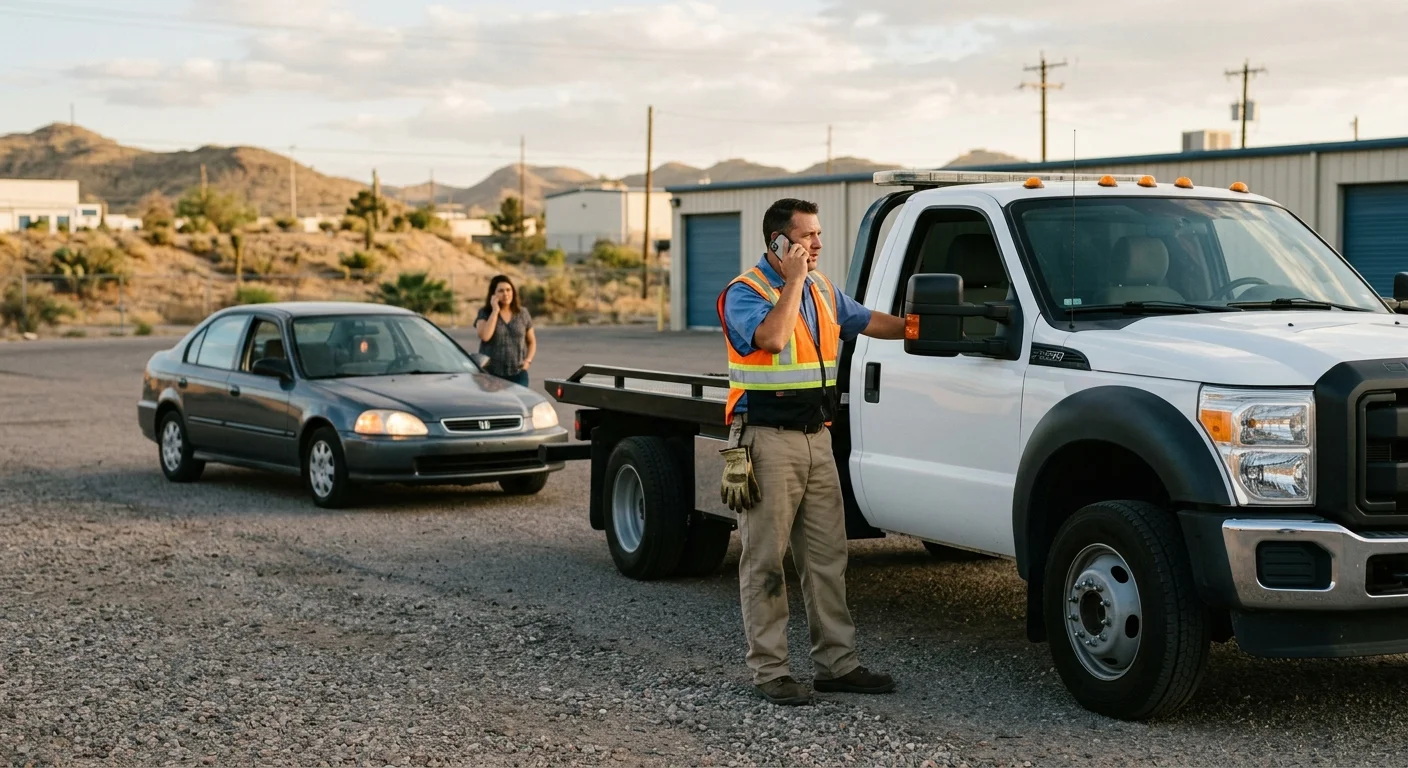
Start with the disabled car, not the truck you hope to use. A search for how to tow a car with a truck usually begins in a lot off Mesa, a shoulder on I-10, or a space in Horizon City. The pickup is already there. The car is not a trailer until someone who is licensed to move it says it can leave on a hook, a wheel lift, or a bed.
Tell us what the car is doing right now. A sedan that died in park on a level pad is a different job from a troca with a flat, a locked column, or a wheel off. All-wheel drive, a hybrid, or an EV that ran out of charge is a different job again. A classic with low ground clearance is not the same as a daily driver with four good tires. If you only have another car, not a pickup, stop there. Towing a car with another car is not a backup plan we can bless from a blog.
Keys matter. If they are in the cabin, say so. If they are missing, say that too. A car stuck in park, a column that will not unlock, and a transmission that will not go to neutral all change how an operator approaches the vehicle. None of that is a reason to loop a strap to a bumper and pull.
Damage matters as much as make. A car that will not start in a Cielo Vista lot is one scene. A car that left the pavement on Transmountain, sat in standing water after a storm, or took a hit on Loop 375 is another. The operators we dispatch recover those scenes with the equipment they bring. Your pickup is not that equipment.
People also ask whether it is legal to tow a car with a truck. Texas requires towing companies and operators who control tow trucks on public roadways to hold TDLR licenses. You can check a company or operator at the TDLR license search. What a private owner may do with a hitch, a rented dolly, or a chain on a city street is not in our verified claims. We could not confirm a statute that says yes or no for that private hookup. Treat it as unconfirmed, and do not copy a how-to from a forum. Ask the operator we connect you with, and read both vehicles’ manuals before you decide to skip the call.
Compare a planned self-tow with a service call
A planned move and a breakdown are not the same job. A family that wants a car to travel with a rental truck is shopping equipment on a calendar. A driver who needs to call a tow truck for my car is standing next to a disabled vehicle on a live street. Mixing those two searches is how people end up with a pickup, a strap, and no confirmation that the car can even be pulled.
A planned self-tow, if you still choose it later, lives in the manuals and in whatever rental yard you use. That is their process, not ours. Quick Tow El Paso does not rent dollies, sell hitches, or walk you through a hookup. We answer the line and route you to a licensed, insured operator. You contract with that operator for the work.
A service call is the right frame when the car is already down. Compare the two on risk, not on pride. Self-tow puts your pickup, your hitch, and the disabled car in one moving pair on I-10, Dyer, Alameda, or a two-lane stretch of North Loop Drive. A service call puts a wrecker built for the job between you and that pair. Professional towing vs self towing is not a personality test. It is whether the disabled car, the road, and the manuals still leave you a private option.
Cost is the other comparison people want. The cheapest way to tow a car is not a number we can invent. For a light-duty service call we dispatch, the starting figure is a $95 hookup plus a per-mile rate. That is a starting figure, not the total. The operator sets the rest and you confirm it before pickup. We do not publish a per-mile rate, a flat rate, or a promise that nights cost the same as noon.
If the car has to go a long way, including a 500-mile move, we also do not have a verified total. Ask the operator for that quote. Our long-distance towing cost notes cover what to confirm on a longer haul. Do not attach any dollar figure to a New Mexico drop in Sunland Park or Anthony. That side of the line is a different quote, and we do not publish one.
Nonconsent tows (the ones you did not call for) have statewide TDLR maximums: $272 for vehicles 10,000 pounds or less, $380 for 10,001 to 25,000 pounds, and $489 per unit up to $978 for heavier units. Those caps are law, not our price list. A consent call you place is priced by the operator, starting from that $95 hookup plus mileage.
Check verified ratings and manuals before deciding
Before anyone connects two vehicles, open both books. The pickup’s owner’s manual and the disabled car’s manual are the verified ratings that belong to those machines. Door-jamb labels, tire placards, and hitch plates on the truck are the labels the maker put there. We do not publish tow ratings, hitch classes, tongue weights, speed limits for a pulled car, or a safe distance for a private pull. If it is not on the vehicle or in the manual, it is not a fact we can give you.
Read the disabled car as closely as the truck. Many makers restrict flat-towing, dolly use, or any pull that leaves drive wheels on the pavement. All-wheel drive and some automatics are common stops in those pages. An EV or a low-clearance car may be barred from methods that look fine on a 1990s sedan. If the manual says the car must ride on a bed, that is the answer, even if a pickup is sitting next to it.
A tow dolly is not a pickup bumper. If you are even considering rental equipment on a planned move, that is a different tool with its own limits. Our notes on what a tow dolly can and cannot carry stay on that equipment. They are not a green light to improvise with rope in a Cielo Vista lot.
Insurance is the other page people skip. Whether a policy pays for a private pull, a rented dolly, or a dispatched wrecker is a question for the carrier. We do not invent coverage rules. If the car is already down, calling us and letting the operator quote is the clean path. You can still call the insurer after you know how the car will move.
July in El Paso is not a gentle waiting room. The National Weather Service normal high for July is 96.1°F. Summer days run in the mid-to-upper 90s, and some run hotter. Standing between two vehicles with hardware you have not confirmed is a long way from a shaded shop. If the manuals are in the glove box and you can read them, do that in a safe spot. If you cannot, describe the vehicles on the phone and let the operator decide the method.
Describe the location, wheels, and steering
El Paso is not one street. A stall on the Westside under the Franklin Mountains is a different approach from a stall in the Northeast, Central, or the Lower Valley. Horizon City sits out east on the Horizon Boulevard corridor, with access from I-10 at Eastlake Drive. Socorro, Clint, and the run toward Fabens sit on and near FM 76, the road most people call North Loop Drive. Much of that corridor is still a two-lane, two-way rural road with 4-foot shoulders, widening to four lanes only north of Horizon Boulevard. A private pull that might feel possible in a wide lot is a bad idea on that pavement.
Say the exact place. A pin, a cross street, a business name, and which side of I-10 or Loop 375 you are on all help dispatch route the right operator. If you are on a shoulder, stay out of the travel lane. Texas’s Move Over law covers stationary tow trucks using proper lights. Other drivers must change lanes away from that truck or slow as the statute requires. First-offense fines run $500 to $1,250. That law protects the wrecker, not a pickup you backed up to a bumper.
Wheels are the next fact. Count them. Say if one is missing, flat, or turned against a curb. A car with four inflated tires on a level pad is not the same as a car with a wheel gone or a tire in a wash. What dispatch needs when a wheel is missing is a separate conversation. Do not drag a rim. Do not guess which axle can stay down.
Steering is the fact after that. If the column is locked, say it. If the car is stuck in park, say it. If you have no keys, say it. Operators plan the pickup around those constraints. A locked column and a drivetrain that cannot freewheel are reasons to wait for the wrecker, not reasons to yank the car into motion.
If you are near Sunland Park or the New Mexico line, say which state the car is sitting in. Dispatch needs that before an operator rolls. We still will not quote a New Mexico price in this article.
Let the operator confirm whether a tow is possible
The last decision is not yours to force. Call us, describe the car, and let the operator we send confirm whether a tow is possible and how it should ride. Quick Tow El Paso is a dispatch and referral line. We do not own the wrecker, hold the TDLR license, or run a yard. The customer contracts with the licensed, insured operator who does the work.
That confirmation is the point of which towing service fits your vehicle. A wheel-lift and a flatbed are not interchangeable. Some cars need the bed. Some can leave with the drive wheels up. The comparison of flatbed vs wheel-lift towing in El Paso is the operator’s call on scene, based on the vehicle you described. We can help you name the problem. We cannot pre-approve a pickup-to-car hookup from a blog.
Have the details ready: year, make, drivetrain if you know it, keys, park or neutral, wheel condition, and the street. What to have ready when you call for a tow is the same list, whether the car is in an apartment space or on the Border Highway. Ask the operator for the price before the hook goes on. Ask for an arrival estimate from that operator. We do not publish one.
If the scene is a crash, a ditch, or a car off the pavement, say that up front so dispatch can route accident recovery instead of a simple hook. If the car only needs a jump, a tire, or fuel, roadside help may be enough. If it has to leave, the operator confirms the method. Your pickup stays a pickup.
When to call us
Call when the car will not move on its own, when the manuals do not clear a private pull, or when the street is I-10, Loop 375, Transmountain, North Loop Drive, or any lot you cannot safely work in. Call us at (915) 615-2224 and we’ll connect you with an operator who handles this work.