A missing title does not stop you from calling for a tow. It does stop a licensed operator from treating the job as a simple hookup. In El Paso that usually means a non-runner in a Central driveway, a pickup on a Lower Valley lot, or a car that has sat through summer heat off Horizon Boulevard. Quick Tow El Paso is a dispatch and referral line. We connect you with a licensed, insured operator. We do not buy cars, hold titles, or run a yard.
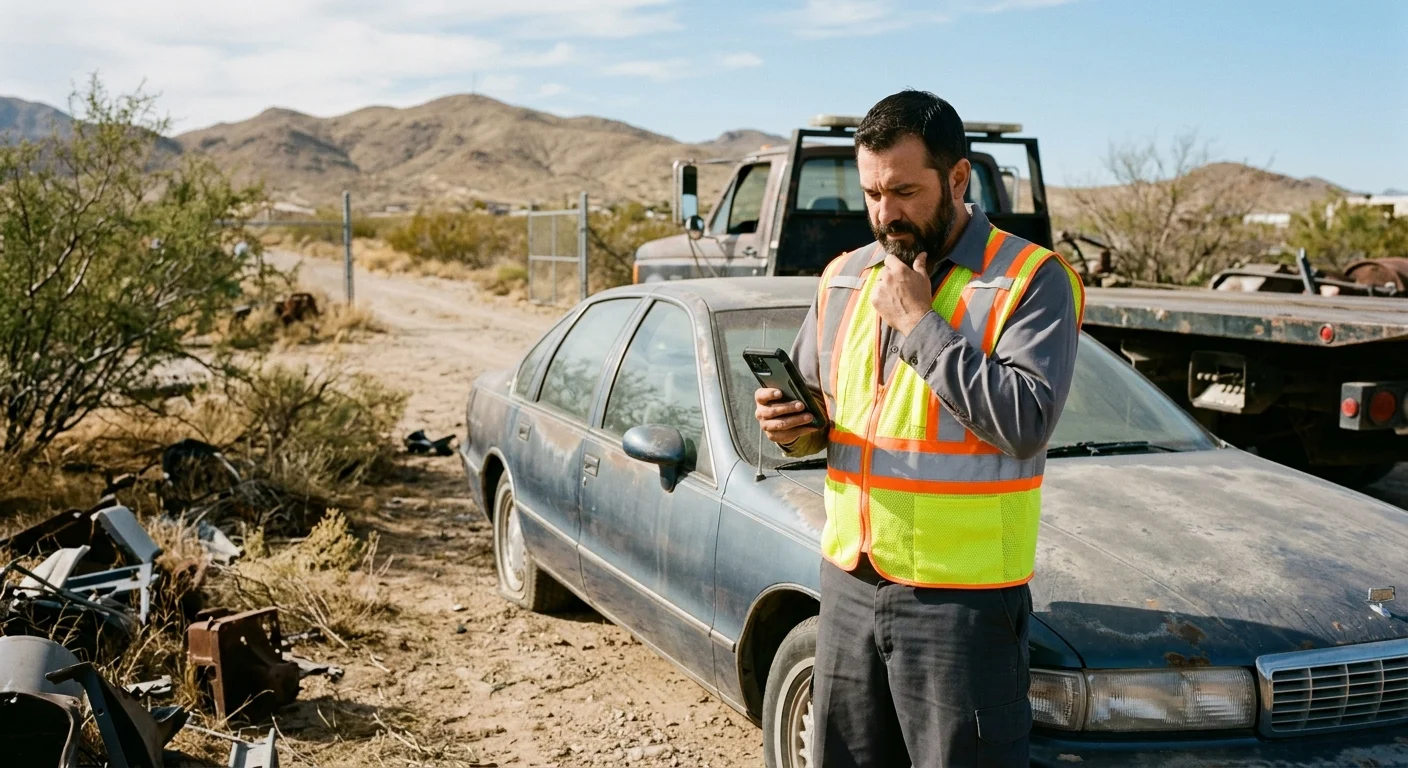
Confirm that you’re authorized to act
Start with who has the right to move the vehicle. A tow for a junk car with no title is only as clean as the person who requests it. If you hold the registration in your name, say so. If you are a spouse, adult child, landlord, HOA manager, or neighbor, say that too. Do not guess. The operator we dispatch needs a clear story of authority before the truck rolls.
Your own car, sitting on your own property, is a consent job. You are asking for a pickup, not a private-property grab. That is a different path from having someone else’s car pulled off a lot. Texas treats nonconsent tows under Occupations Code Chapter 2308. Those tows can trigger storage rules, notice, and a hearing right. A hearing request on a nonconsent tow must be filed within 14 days, excluding weekends and holidays, after the vehicle is placed at a storage facility. That clock does not apply when you summon the truck yourself. Mixing the two is how people get stuck.
If the car is not yours, pause. A property owner can still ask about private property towing. Cities and counties may add local registration for nonconsent work. We could not confirm any City of El Paso ordinance, police rotation, or local fee cap from our verified claims file. Statewide TDLR rules are not city rules. Ask the operator what they need in writing, and check with the city or county if the vehicle belongs to someone else.
Location matters here in a way a generic page will skip. A sedan behind a house in Central El Paso is not the same job as a car on a two-lane stretch of North Loop Drive, the local name for FM 76, through farmland toward Socorro, Clint, and Fabens. Horizon City sits east of I-10, with access off Eastlake Drive onto Horizon Boulevard. Sunland Park is across the New Mexico line. Title and disposal rules change at a state border. We could not confirm New Mexico title substitutes, and we do not quote New Mexico prices.
Tell dispatch who you are, whose name is on the last registration you can find, and whether anyone else might claim the car. If there is a lender, a lease, or an estate, say that up front. We could not confirm Texas estate or lien-release shortcuts. Direct those questions to the Texas Department of Motor Vehicles, the county tax office that handled the registration, or a Texas attorney. Then tell the operator the same facts so they can refuse the job if they cannot take it.
Gather available vehicle and ownership records
You do not need a perfect file to call. You do need every scrap that proves the car is the car, and that you are the person calling about it. Pull the VIN from the dashboard or door jamb. Photograph it. Note the plate if one is still on the car. Year, make, model, color, and where it sits are the next details. A 1990s sedan in a Northeast cul-de-sac and a work truck off Alameda are not interchangeable loads.
Texas towing storage rules list several ownership proofs for retrieving a vehicle from a vehicle storage facility. Those include a driver’s license that matches the registration, an insurance card for the vehicle, the vehicle title, a tax collector’s receipt, a lease or rental agreement, and TDLR-provided forms. That list is for getting a stored vehicle out of a yard. It is not a confirmed list of documents that let you scrap or transfer a car with no title. Do not treat it as a junkyard checklist.
If the title is lost, start with the Texas Department of Motor Vehicles and the county tax office tied to the last registration. We could not confirm a replacement-title fee, wait time, or a no-title scrap form for El Paso County. Those figures change, and inventing them would send you in with the wrong paper. Ask the agency what they issue now. Ask whether a bonded title, a certified copy, or another process even exists for your case. Then tell the operator what you were given.
Bring photo ID. A state driver’s license, a federal ID, or a foreign-government ID is what TDLR lists for retrieval from storage. Have that ready even if this pickup never goes to a storage facility. Operators still need to know who they are dealing with. Keep insurance cards, old inspection printouts, and any bill of sale in one folder. If you have a lien payoff letter, keep that too.
Do not promise the destination a title you do not have. The broader junk car removal checklist for El Paso covers condition, access, and destination. This page is narrower: no title in hand. That gap is the whole job. Fill it with records, not with guesses. If nothing turns up, say so. An honest “I have the VIN and an old insurance card” is more useful than a story about a title that may still be with a lender in another state.
You can verify that the operator we send is licensed through TDLR’s license search at https://www.tdlr.texas.gov/LicenseSearch/. Search by tow truck operator, name, city, county, or zip. That check is about the truck, not about your paperwork. Both still have to line up before the car leaves the lot.
Describe the keys, wheels, and access
Paperwork gets you to the curb. The truck still has to load the car. Say whether you have keys. Say whether it shifts, rolls, or steers. A car in park with frozen brakes after a July sit is a different setup from a roller you can push onto a bed. El Paso’s July climate-normal high is 96.1°F. Summer highs normally run in the mid-to-upper 90s. Seals dry, batteries die, and tires go flat. Tell dispatch what you see.
Wheels decide the method. If a wheel is gone, a hub is on a jack stand, or the car is sitting on the dirt, say that in the first call. Our missing-wheel dispatch guide is the detail list for that setup. A wheel-lift may not be the right tool. A flatbed is often the honest answer for a junk non-runner, especially if the steering is locked or a tire is missing. The operator on scene chooses the equipment. You still have to describe the problem so the right truck is sent.
Access is local, not generic. Westside streets under the Franklin Mountains can be steep, gated, or tight. Central alleys and apartment courts leave little swing room. Northeast cul-de-sacs fill with parked cars after work. Lower Valley and Horizon City jobs often mean longer rural runs. FM 76 is mostly a two-lane, two-way road with 4-foot shoulders for much of the TxDOT study corridor from Horizon Boulevard to Alameda Avenue in Fabens. It widens to four lanes only north of Horizon Boulevard. Farm and residential lots along that stretch may have dirt, irrigation edges, or a long private drive. Say whether the truck can reach the car without crossing a field, a ditch, or a locked gate.
Name the nearest cross street, not just the city. “Behind the house on the Socorro side of North Loop” is usable. “El Paso” is not. If the car is in an apartment space, say whether management has to open a gate. If it is blocking a driveway, say who owns the driveway. Do not leave the VIN plate, battery, or catalytic converter story for later if parts are already gone. Missing parts change how the operator loads and how a yard, if one is even willing, looks at the car.
Clear personal items before pickup. TDLR requires free access to documents and personal property when a vehicle is in a storage facility. A consent junk pickup is not that setting. Take what you want out of the cabin and trunk yourself. Do not assume the driver will inventory the glove box. Ask the operator, before they hook, what they will and will not move around.
Check current title and removal requirements
This is the question people type: can you tow a car with no title. The honest El Paso answer is that the operator and the destination set that, under Texas rules we could not fully confirm in our claims file. We can confirm how towing itself is licensed. We cannot confirm a city scrap ordinance, a waiting period, or a document that always replaces a title.
Texas towing companies that control tow trucks on public roadways must be licensed by TDLR. Operators hold incident-management, private-property, or consent licenses by the type of work they do. That license does not, by itself, let anyone sell, crush, or transfer your car. A tow company is not a title office. Quick Tow El Paso does not sell vehicles and does not take ownership. If someone tells you a wrecker can cash you out on the spot with no paper, treat that as unverified. We could not confirm a Texas path that lets an operator sell a no-title car on your behalf.
For a car you own, the live question is what TxDMV will issue and what a licensed recycler will accept. Call TxDMV. Ask the county tax office that last handled the registration. If a yard is in the plan, call that yard before you request the truck. Read back their document list to the operator we dispatch. If those two lists do not match, the car can get hooked and then refused at the gate. That is an expensive stall, and it is avoidable.
For a car that looks abandoned on someone else’s land, do not improvise. City of El Paso removal rules, impound details, and local waiting periods are not in our verified file. Statewide TDLR consumer rules cover storage rates and retrieval from a vehicle storage facility, not a municipal abandoned-auto program. Storage, where it applies, is charged per day or part of a day, with TDLR stating a 2023 adjusted rate of $22.85 per day for vehicles 25 feet or less. That is a storage figure, not a junk-removal price, and it is not a City of El Paso fee.
Liens, leases, and out-of-state titles all change the file. We could not confirm how El Paso County treats those. Name the problem. Let the agency and the operator answer it. Ohio, Pennsylvania, Nevada, and North Carolina pages you may have seen online do not apply here. Texas is TDLR for the tow, and TxDMV for the title. Keep those two lanes straight.
Plates are a separate errand. We could not confirm whether you must mail them in, keep them, or surrender them at the tax office. Ask TxDMV. Remove what you can from the car so you are not hunting a registration sticker after the truck is gone.
Confirm the destination with the operator
A no-title junk car still has to go somewhere. That somewhere is not our yard, because we do not have one. Junk car and abandoned vehicle removal in this network means we dispatch a licensed operator for the haul. The operator and the receiving site decide whether they will take the car in its current paper state. Confirm that destination before anyone hooks up.
Say the address you want used. A shop on the Eastside, a private lot in Horizon City, a family property in the Lower Valley, and a recycler you already called are four different jobs. Mileage, road type, and gate access all change. The operator sets the price for a consent tow. Confirm it with that operator before pickup. We do not offer a flat rate, a firm written quote from this desk, free removal, or cash for the car. We do not promise the same number at every hour. If the job is a nonconsent tow, Texas sets statewide maximums: $272 for vehicles 10,000 pounds or less, with lower drop fees if the car is fully hooked and then released on the spot. Those caps are law, not our menu, and they do not apply to a job you request yourself.
Do not send the truck across the state line on a hunch. Sunland Park, Anthony, and other New Mexico-side spots sit in a different title system. We could not confirm what a New Mexico yard will take without a Texas title. We also do not attach any dollar figure to a New Mexico tow. If the car is in Texas and the destination is in New Mexico, or the reverse, say both addresses. Let the operator refuse if they cannot complete it.
Ask what happens if the gate turns the car away. That is the failure mode on no-title jobs. Get a backup location from the operator, or wait until TxDMV has issued whatever replacement they will issue. Honest delay beats a car stranded on a wrecker. Rural drops toward Clint and Fabens, and tight Westside drives, take more time on scene once the truck is there. Ask the operator for an arrival estimate. We cannot promise one from this line, because we do not control which licensed truck is closest.
If the car will sit in a vehicle storage facility instead of going straight to a destination you named, TDLR’s retrieval rules apply: photo ID, an accepted proof of ownership, and payment of towing and storage before release. Access to grab documents and personal items from a stored vehicle is free. You still have to show up with proof. Keep that in mind if “junk it” turns into “hold it” because the title file is incomplete.
When to call us
Call when the car is yours to move, or you already have written authority, and you need a licensed operator to haul a junk or unwanted vehicle you cannot drive. Have the VIN, the access notes, and whatever ownership records you found sitting next to the phone. Call us at (915) 615-2224 and we’ll connect you with an operator who handles this work.