The shifter will not come out of park, so the car will not roll. You are not looking for a remote diagnosis. Dispatch needs what you can see from the seat so a licensed operator can decide whether a move is even possible.
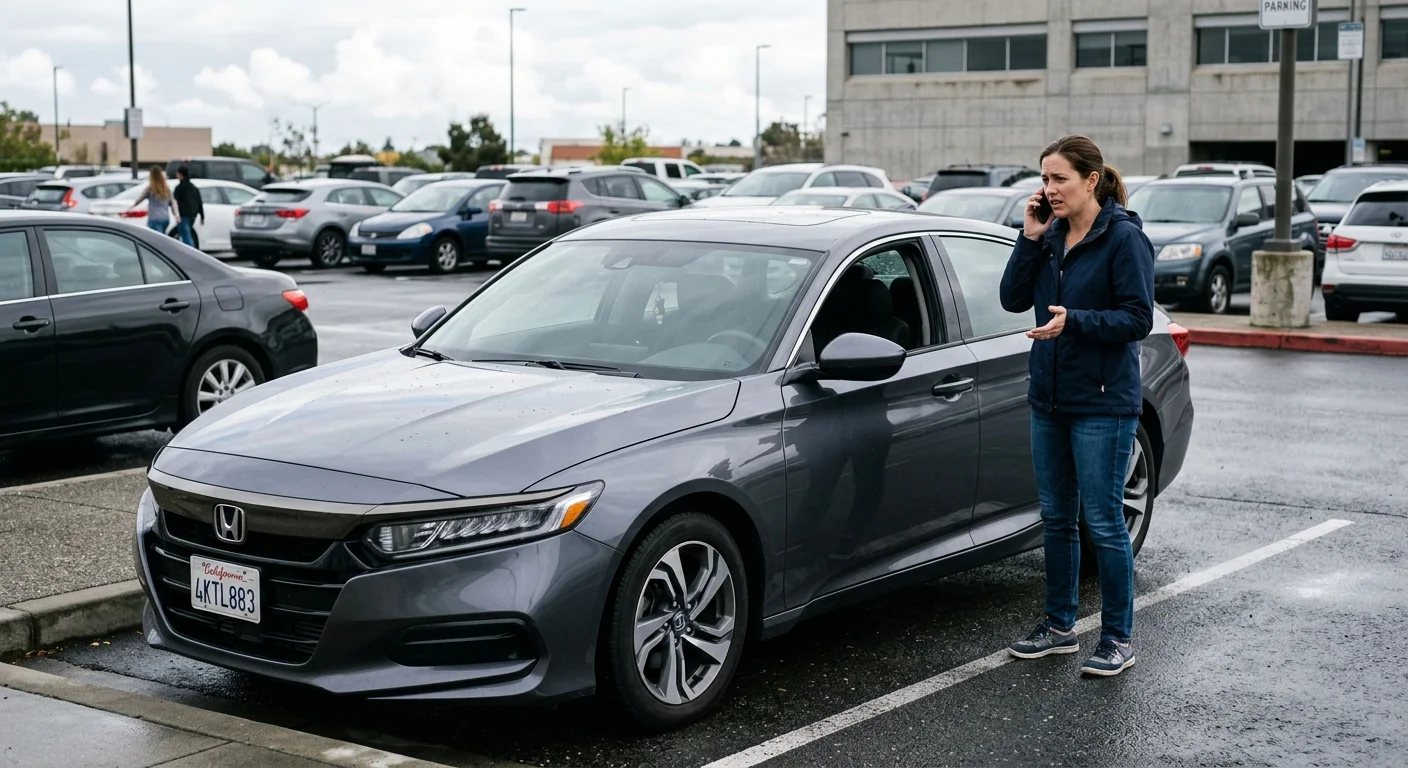
Describe what the shifter and wheels are doing
A tow for a car stuck in park starts with two observations, not a parts list. Say what the shifter does. Then say what the wheels are doing.
The shifter report should match what you just felt. It will not budge. It moves a little and springs back. It slides, but the dash still reads park. Those are three different calls. Use the one you have. If a message or warning light is on, read it out. If the dash is dark, say the dash is dark. That is an observation. It is not a diagnosis of the transmission, the brake switch, or the battery.
Then look at the wheels, and only if you can do it without stepping into traffic. On a level stall in Central El Paso, a car in park often sits like it is bolted down. On a grade off Transmountain Road, or a tilted garage deck downtown, the same car may want to creep if anything lets go. Say whether the ground is flat, downhill toward a curb, or nose-up against a wall. Say whether you felt any roll when you took your foot off the brake.
Do not pull harder on the handle. Do not pry a cover off the console. Do not rock the car to “free” it. Forcing the shifter is how a transport job picks up a broken selector. Pushing a car whose wheels will not rotate is how you add scraped bumpers and a second problem for the shop.
If a parking-brake pedal, handle, or switch is set, say so. If you cannot tell, say you cannot tell. “I think the brakes are fine” does not help the operator we connect you with.
A car that will not leave park is immobilized in a different way than a car with a missing wheel. Both may refuse to roll. The story you give still has to match the condition in front of you.
Location changes the risk around those locked wheels. On I-10, Loop 375, or the Border Highway, stay out of the travel lanes if you can. Treat that as emergency towing intake: exact place first, then the park-lock report. Texas’s Move Over law applies when a stationary tow truck is using proper lights. Other drivers must vacate the nearest lane on a multi-lane road, or slow to no more than 20 mph below a posted limit of 25 mph or more. You still need to stay off the pavement.
If you are on North Loop Drive in the Lower Valley, that is FM 76. TxDOT’s study corridor runs about 12.5 miles from Horizon Boulevard to Alameda Avenue in Fabens. Most of it is two lanes with four-foot shoulders. A disabled car there sits closer to live traffic than it would in a wide east-side parking aisle. Say you are on a two-lane stretch. Do not say “somewhere out east.”
Say whether the keys are available
Keys change the job before anyone hooks a chain or a bed.
If the keys are in your hand, say that. If they are in the ignition and the column will not release them, say that. If they are locked in the cabin, say that. If this is a fob and the fob is dead, say you cannot open a door or get the shifter to respond.
Do not start a teardown to find an override slot. Makes and models differ. A key or a screwdriver in the console is not a tow plan, and it is not self-recovery. Stay out of the mechanism.
The operator still needs to know whether a door opens, whether the steering is locked, and whether you can sit in the seat and hold the wheel if they ask. You do not have to promise those things will work. Report what you can do right now.
No keys is its own constraint. We keep a separate walkthrough for towing when the keys are missing. Use that if the fob is gone. On this call, still say “no keys” out loud so intake does not assume you can shift, steer, or unlock.
If someone else has a spare, say where they are in plain El Paso terms. “The spare is in Horizon City and I am in a downtown garage” is useful. “Someone might have a key” is not. Horizon City sits east of the city proper. The main commercial run is Horizon Boulevard (FM 1281), with access from I-10 on Eastlake Drive. That is a real delay for a spare, not a maybe.
Leave the cause alone. A clicking starter, a working radio, or brake lights that do not come on can be mentioned in one sentence. Then stop. We are not tracing a fuse, a solenoid, or a parking-brake motor from the phone.
If the car is a rental, say so on the first call. The rental company may want a say in the destination. That is their contract. It is not ours. Quick Tow El Paso answers the line and routes you to a licensed, insured operator. You contract with the operator who does the work.
Share clearance and access conditions
The operator cannot guess the lot. Clearance is how they decide whether a truck can even reach you.
Give the surface: asphalt lot, concrete garage, packed dirt off a Lower Valley farm road, gravel behind a shop on Alameda. Give the room around the car. Tight downtown stall. Open big-box aisle. Parallel spot on Mesa. End space in a Westside carport under the Franklin Mountains, with a beam over the hood. You are not picking the truck. You are describing the hole it has to fit. A flatbed and a wheel-lift truck do not need the same envelope. The driver on scene chooses equipment. Your job is the tape-measure version of the scene.
Name gates, tickets, and bars as you see them. “The arm is down and I cannot pull a ticket” matters. “There is a height bar” matters. We have not verified every garage rule in El Paso from a city page, so we will not recite one. Read the posted height if there is a number. If nothing is posted, say nothing is posted.
On Fort Bliss or a gated workplace, say you will need an escort or a pass. Do not wait for us to invent the current gate rule. Ask the gate and pass that answer along.
Residential streets change the approach too. A stuck car in a Horizon City cul-de-sac is not the same as a stall on a Horizon Boulevard strip center. Northeast lots off Dyer do not stage like a Lower Valley pullout on FM 76 near Socorro or Clint. If an HOA arm, a speed bump, or a dead-end is between the truck and the car, say it.
Sunland Park sits across the New Mexico line. If you are there, say you are in New Mexico, not “west El Paso.” Texas price language does not travel with you. The operator quotes that run on its own. We will not attach a dollar figure to a New Mexico tow.
If a second car is boxing you in, say which side. If a bollard, cart corral, or landscape island sits on the open side, say that too. Summer heat is part of access as well. El Paso’s July climate-normal high is 96.1°F. If you can wait in a store, a shaded wall, or a running cab without losing the car, do that. Do not stand in a travel lane to “watch the shifter.”
Give the pickup and destination details
A car that will not leave park still has a from and a to. Dispatch needs both before they can route an operator.
Pickup means city or neighborhood, then the nearest cross street, then the name on the building if there is one. “Northeast, Dyer and Hondo Pass, south-side lot” is a location. “By the mall” is not. “Westside, up Transmountain from I-10, in the pullout” is a location. “In the mountains” is not.
If you are on I-10, give the direction, a mile marker if you can see one, and the last exit you passed. If you already dropped onto a frontage road, say that. It keeps a truck off the mainline hunt. If you are on Loop 375, name the segment: Border Highway, the east loop, or the northeast. If you are in Socorro, San Elizario, or Fabens, say the town, not “the valley.”
Destination is a street, not a vibe. Home, a dealer, an independent shop, a lot you already chose. If you have not chosen a shop, say you need the car at a safe address first. The operator can talk destination once they know the car will move at all.
Do not assume we hold a yard. We do not own trucks, run a warehouse, or keep an impound lot. We dispatch. The operator you are connected with is who you pay and who you follow up with on the drop-off.
If the destination is another city, say so up front. A run from Socorro toward Fabens along FM 76 is still El Paso County. A run that crosses into New Mexico is a different conversation, and it gets no Texas dollar figure from this page.
For a normal El Paso light-duty move, the starting figure we can state is a $95 hookup plus a per-mile rate. That is a starting figure, not the total. The operator sets the price for the actual job. Confirm it before the truck leaves with your car. There is no approved flat-rate promise on this line, and no night or weekend price we can recite.
Bring what you will need at the other end: ID, a way to pay the operator, and any shop or insurance notes you already have. If the car later ended up in storage without you, retrieval rules are a different process. This page is for the call you make while the car is still where it died.
Let the operator decide whether a move is possible
You called because the car will not leave park. The next honest sentence is that a move is not automatic.
The driver we connect you with looks at the shifter report, the wheels, the keys, the slope, and the room to work. They decide if the car can be loaded as it sits. They decide if it has to wait for different equipment. They decide if it should not be moved until a shop can see it in place. That call belongs to the licensed operator on scene. It does not belong to a search result, and it does not belong to a guess from the shoulder.
We will not walk you through a loading method here. Advice to drag the car, jump it until it shifts, or “just put it in neutral” is how people crease rocker panels and snap selectors. If a page promised that towing in park never causes damage, it oversold. If a page promised it always destroys the drivetrain, it oversold that too. Damage depends on the car, the surface, and the method the operator chooses after they see it. Ask them what they plan to do. Stay clear while they do it.
Texas towing on public roadways is licensed work. Operators hold TDLR credentials by tow type: incident management, private property, or consent. Companies that control tow trucks on public roads need a license too. You can look an operator up on TDLR’s license search. Search by name, city, or license number. The pros we connect you with are licensed and insured. We are not the licensee on the truck.
Stay with the vehicle if it is safe. If it is not, get to a sidewalk, a storefront, or the far side of a barrier and keep the phone on. Do not stand in an I-10 lane to help. If law enforcement is already there and they want the travel lane cleared, say that to dispatch in those words.
When the operator arrives, answer the same questions you answered on the phone. Do not start the engine “one more time” in the middle of a hookup unless they ask. Do not reach back into the shifter while they are working. Your report got them there. Their eyes on the car decide whether it leaves.
When to call us
Call when the car will not leave park and you need it moved by a licensed towing pro, not when you want a remote diagnosis. Stay out of the shifter and off the street. Call us at (915) 615-2224 and we’ll connect you with an operator who handles this work.