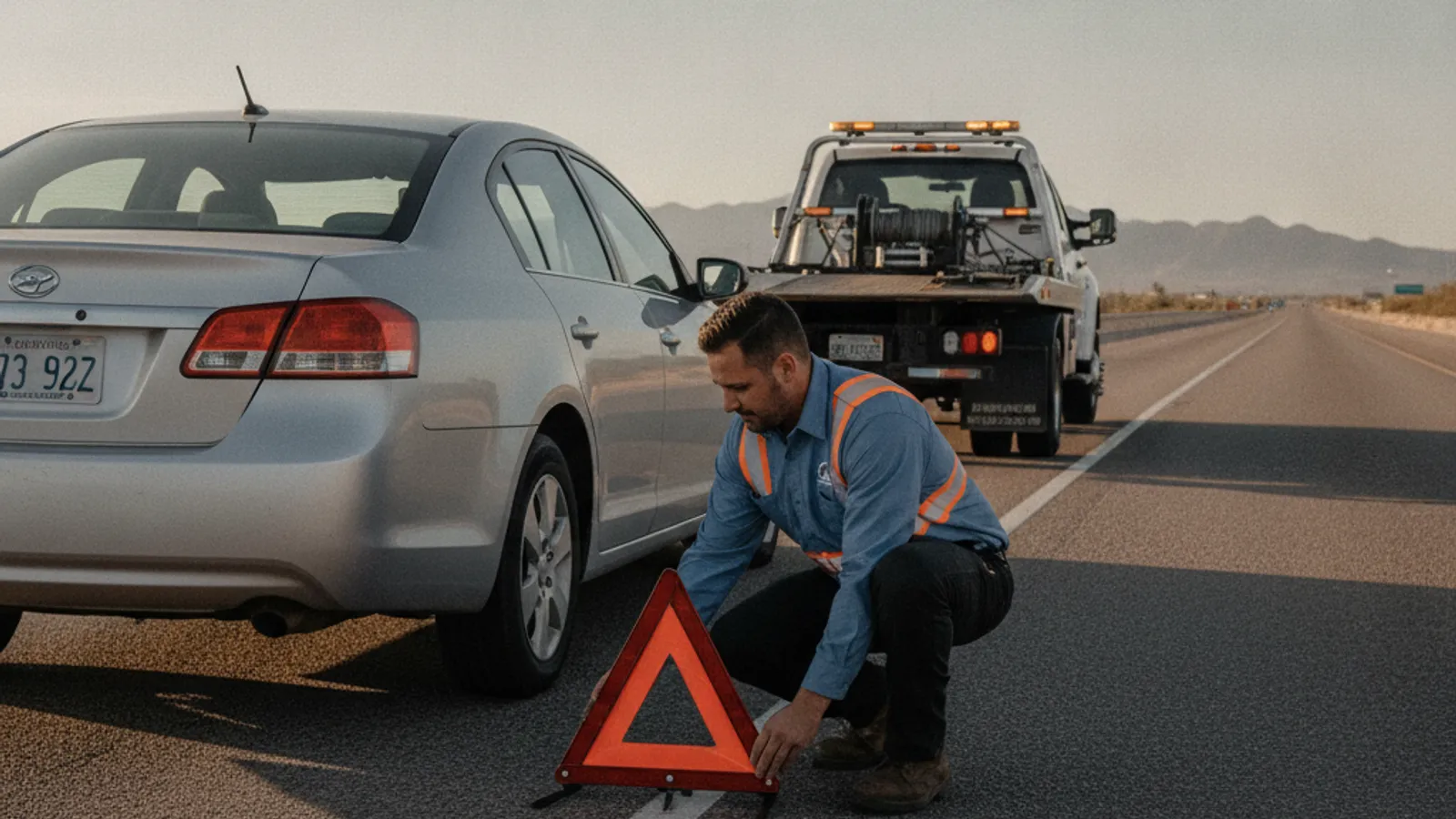
If you’re stuck on a live highway shoulder, stay inside the car with your seatbelt on and call before you touch the jack. If you’re safely off the road, in a parking lot or on a quiet street, and you’ve got a usable spare, you can often handle it yourself in a few minutes. Either way, call (915) 615-2224 and we’ll tell you which one applies to you. A roadside tire change is priced by the operator on the call. If your spare’s missing or shredded, a light-duty flatbed to a shop starts at a $95 hookup plus a per-mile rate, a starting figure, not the total.
Should you change it yourself, or wait for us?
The traffic side of a highway shoulder is not the place to learn how to use a jack. If you’re on I-10, Loop 375, or US-54, keep your seatbelt on, hazards flashing, and wait inside the car. The truck that reaches you will pull in behind you with warning lights as a buffer before anyone steps out.
A parking lot, a quiet residential street, or a wide gravel pullout is a different situation. If you’ve got a spare, a jack, and the lug nuts aren’t seized, you can usually be back on the road in fifteen or twenty minutes on your own. Just remember the spare is a get-you-home tool, not a real tire: most are rated for 50 mph and about 70 miles before you need a shop.
Texas also runs a free program worth knowing about. TxDOT’s HERO patrol changes flat tires on I-10 from Transmountain Road to Horizon Boulevard, on Loop 375 from I-10 West to Paisano, and on US 54 from McCombs to Loop 375, Monday through Friday 5 a.m. to 9 p.m. and Saturday through Sunday 9 a.m. to 9 p.m. Call 915-790-4376 if you’re on one of those exact stretches during those hours. Off those corridors, overnight, or in a lot, a dispatched tow is the option that actually shows up.
What if your car doesn’t have a spare?
More new cars skip the spare entirely now, and almost every EV does too, shipping with a sealant kit instead of a fifth wheel. If the puncture is small, sits in the tread, and the sidewall’s still intact, sealant or a plug can sometimes hold long enough to reach a shop. A shredded tire, a blown sidewall, or a bent wheel means sealant won’t do anything, and you’re looking at a spare, if one exists, or a flatbed to the nearest tire shop.
Tell us your year and model when you call. Dispatch knows which vehicles ship without a spare, so the driver shows up with the right plan instead of guessing on scene.
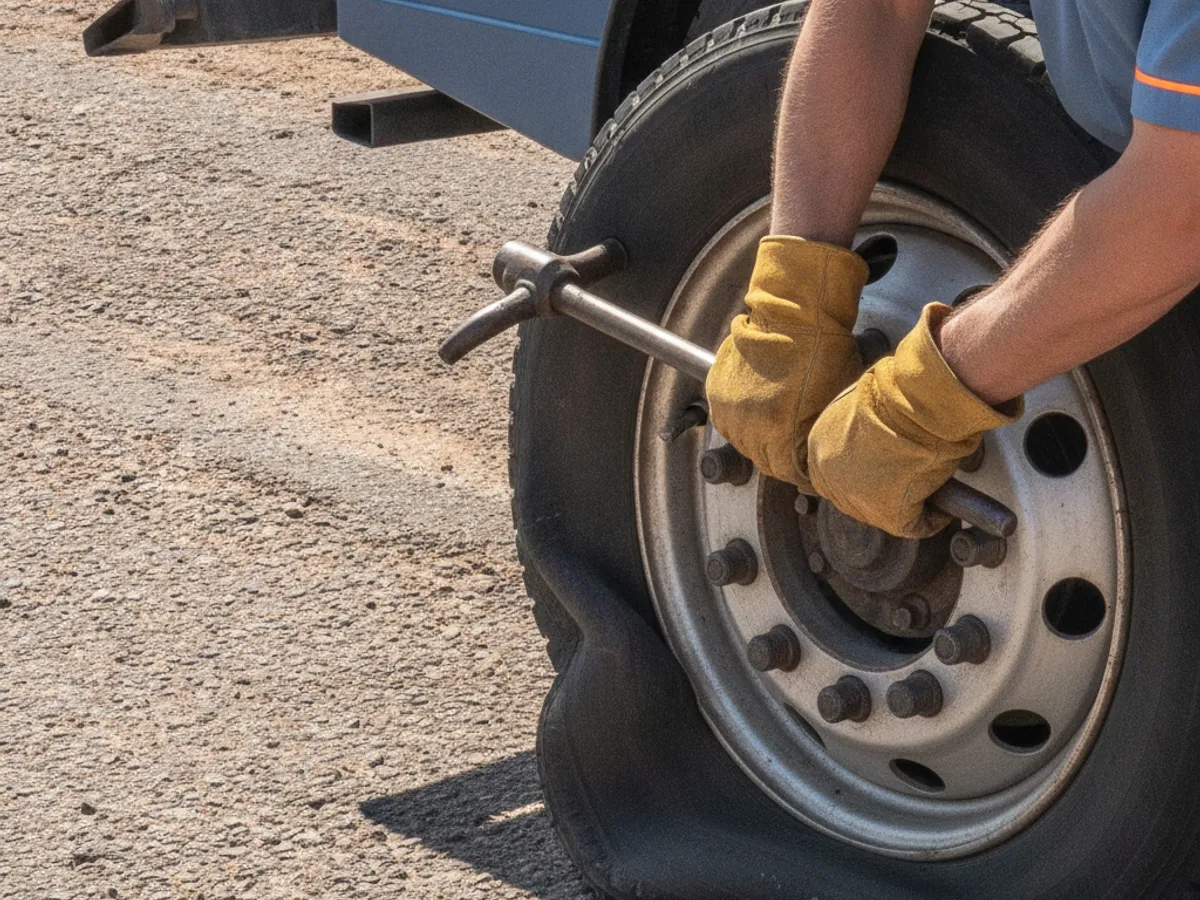
Where do most flat tires happen around El Paso?
Debris is the biggest cause we see, and it isn’t spread evenly across the metro. Inside the city, calls split between curb strikes in parking lots and debris flats on I-10 and Mesa Street, where construction material on a busy stretch slices sidewalls. Far East El Paso has its own version right now: construction on Montana Avenue and the Loop 375 interchange has left irregular lanes and loose debris that weren’t there a year ago.
Fort Bliss runs differently. PCS season, June through August, brings families and soldiers driving vehicles across the country that haven’t seen a service bay in weeks, and the mix of desert heat and US-54 or Spur 601 asphalt finishes off tires that were already worn thin somewhere else. On the New Mexico side, the I-10 freight corridor near Anthony and the desert roads by Santa Teresa and Chaparral see a lot of retread blowouts from the commercial truck traffic running that stretch all day.
None of that means you did anything wrong. It means the road did the damage before you ever felt the wheel pull.
Does a flat tire need a flatbed or a regular tow truck?
It depends on which wheel is affected and what shape the tire’s in. A wheel-lift truck needs the un-lifted axle to still roll freely, so if your flat is on a drive wheel, or the rim’s bent enough that the tire won’t roll straight, wheel-lift isn’t a safe option. A flatbed carries all four wheels off the ground, which is why it’s the standard call for a flat with wheel damage, a shredded tire, or any vehicle where rolling on three good tires and one flat just isn’t possible.
Both truck types are available, and the dispatcher will ask a few quick questions, what’s flat, whether the rim looks bent, whether you have a spare, so the right truck shows up the first time instead of a second dispatch later.
How much does a roadside tire change cost in El Paso?
A roadside tire change is priced by the operator on the call, not as a published brand fee. If there’s no usable spare and the car needs to go to a shop instead, a light-duty tow starts at a $95 hookup plus a per-mile rate, the same math we break down in our full guide to tow costs in El Paso. The operator quotes the full number on the phone before a truck is dispatched. There’s no membership to buy first. If you already pay for AAA, use it, but if you don’t, skip the annual fee and call direct.
Get your flat changed anywhere in the El Paso metro, today
Quick Tow El Paso dispatches flat tire service across the metro, from Mesa Street and Kern Place to Cielo Vista, Ysleta, Fort Bliss, and Horizon City. If the wheel’s too damaged to roll or there’s no spare to put on, we can arrange a flatbed to a shop from the same call. For anything short of a full tow, from an empty tank to a dead battery, roadside assistance covers what’s needed.
Call (915) 615-2224. Tell the dispatcher which tire, whether you’ve got a spare, and where you’re parked, and we’ll get a truck moving.
Frequently asked questions
How much does a roadside tire change cost in El Paso?
The operator confirms the tire-change price on the call. If you have no usable spare and the car needs a flatbed to a shop instead, a light-duty tow starts at a $95 hookup plus a per-mile rate, a starting figure, not the total.
Is it safe to change a flat tire on the shoulder of I-10 or Loop 375?
Not on the traffic side, no. Stay inside the vehicle with your seatbelt on and hazards flashing, and let the driver position the truck with warning lights as a buffer, or do a short tow to a safe lot first.
What if my car doesn’t have a spare tire?
A lot of newer models and nearly every EV ship with a sealant kit instead of a spare. A small puncture in the tread with the sidewall intact can sometimes take a plug or sealant. A shredded tire or damaged sidewall means the operator taking the job moves you on a flatbed to the nearest tire shop.
Does TxDOT’s HERO patrol change flat tires for free?
Yes, on I-10 from Transmountain Road to Horizon Boulevard, on Loop 375 from I-10 West to Paisano, and on US 54 from McCombs to Loop 375, Monday through Friday 5 a.m. to 9 p.m. and Saturday through Sunday 9 a.m. to 9 p.m. Call 915-790-4376. Outside those corridors or hours, a private tow is the faster option.
Can a regular tow truck handle a flat tire, or do I need a flatbed?
It depends on the damage. A wheel-lift truck needs the un-lifted axle to roll freely, so a flat on a drive wheel or a bent rim usually calls for a flatbed instead. Local operators cover both, and the dispatcher sorts out which one you need over the phone.
How far can I drive on a donut spare?
Treat it as a get-you-to-a-shop tool, not a real tire. Most spares are rated for 50 mph and about 70 miles. Driving faster or farther than that risks the spare itself failing before you reach help.